Wednesday, March 30, 2022

Found

I preached on the parable of the Lost Son on Sunday, and as I mentioned in the sermon, I found Amy Jill Levine’s book Short Stories by Jesus to be really helpful as I wrestled with the story.

She had these observations about parables that didn’t make it into the sermon, but that I’ve continued to ponder this week:

. . . what makes the parables mysterious, or difficult, is that they challenge us to look into hidden aspects of our own values, our own lives. They bring to the surface unasked questions, and they reveal the answers we have always known, but refuse to acknowledge.

Parables . . . tease us into recognizing what we’ve already always known, and they do so by reframing our vision. The point is less that they reveal something new than that they tap into our memories, our values, and deepest longings and so they resurrect what is very old, very wise, and very precious. And often, very unsettling.

As I shared in the sermon, I’ve come to a new and deeper appreciation for the father’s words to the older son at the end of the parable: ‘My beloved child, you are always with me and everything I have is yours . . .’ I’m still sitting with those words this week, and I keep running into these lost and found parables in my daily life.

On Friday night last week we went to see the Grand Rapids Christian Middle School production of Godspell Junior. We haven’t been to a play in a long time, and I wore my favorite bright pink embroidered blouse from Mexico with my bright yellow scarf from London and a favorite pair of earrings that Jay and the kids gave me several years ago. When we got home after the play, I was only wearing one of the earrings. I really like those earrings – they were from Haiti, they went with lots of things, and they were precious to me because the kids picked them out for me.

The next morning, I texted Jay (who was out with Peter doing Little League tryouts) to ask him to search the car, in case it had fallen out there. I asked Emma if there was a lost and found at the high school that she or I could check on Monday. And I asked Bri, when she went back for the afternoon performance, if she could look for it. She reminded me that she would be backstage, so unlikely to be where I lost it. I was heading out for a walk with Luna when both girls said, ‘Just walk over the high school and see if it’s outside.’

The weather on Saturday morning was not pleasant, but the dog and I needed a walk, so we headed over to the high school, and there it was, right by the door, where I had taken off my mask when we headed outside. I cheered – I may have even jumped up and down – I definitely confused Luna who wasn’t sure what was going on. I texted Jay right away – found it! And when I got home, I announced to the girls, ‘I’m like the woman with the coin! We’re even going to celebrate!’ One of them pointed out that we were going to celebrate because it was a belated birthday gathering, not because I found my earring, but I was really glad. Thinking about it still makes me smile.


And, as I said, I’m still thinking about these parables. I try to do the wordle each night and on Monday night, the word was ‘FOUND’.

Wednesday, March 16, 2022

Longing for Coffee

Council is reading the book Soul Feast by Marjorie Thompson together this year. We’re reading a chapter a month and then briefly discussing what we’ve read at the opening of our time together. Soul Feast is a book about spiritual disciplines, and each chapter goes in-depth on a particular way of deepening our spiritual lives.

We’ve already discussed prayer, worship, Sabbath, and several others. The chapter we read for this past Monday’s meeting was on fasting. The author distinguished between fasting from food and “fasting” from other things in our lives that threaten to become more important to us than God (social media, anyone?). Both types of fasting have their place. Fasting from food helps us remember that just as our physical bodies need to be fed regularly, so our spiritual selves need to be nourished regularly as well. Our lives are just as dependent upon God as they are upon food and taking time to fast can remind us that we do not live on bread alone. And fasting from other things helps us keep our lives in proper order and can help keep things that are not God from taking the place of God.

Embedded in this chapter was a brief critique of the practice of giving something up for the season of Lent. Thompson was none too keen on the practice, implying it was more for show than anything else and didn’t necessarily get us into a long-term rhythm where the practice could shape us spiritually over time. At one point she even referred to such things as “frivolities.” This caught my attention, since, for the first time in my life, I’ve actually given something up for Lent. Something that has cost me dearly.

Oh, I’ve tried this before in the past. I’ve given up chocolate. Or I’ve given up sugar. And these forays into Lenten practice have typically lasted about three or four days before I decide that I’ve learned enough and don’t need to sacrifice in this way anymore. Or I’ve simply failed. I’ve caved. I’ve eaten chocolate and then decided it’s not really all that spiritually important anyway and thrown my Lenten practice out the window.

This year, however, has been different. This year I’ve given up coffee. And I’m sticking to it. I was drinking a lot of coffee before Lent. Often well into the afternoon. Enough that Peter saw me one day and noted, “Dad, you drink a lot of coffee.” And he followed it up with, “You should go a week without coffee.” Apparently, I hadn’t had enough coffee that day, because I was just crazy enough to say, “Okay.” And then I was crazy enough to say, “I’ll give it up for Lent.”

This is the first Lent where this practice has been meaningful to me. I used to rely on coffee to get me going in the morning. I would look forward to it with breakfast. I’d have a cup with my Duolingo Spanish homework. I’d sip some while trying to figure out the Wordle of the day. But now there’s a noticeable gap there. Something missing. Orange juice isn’t quite the same. Tea isn’t cutting it. But I’ve noticed I’m more spiritually attuned. I’m very conscious that I’m doing this to remind myself that God is the source of my life—not coffee (or anything else). It’s led me to pray more (mostly without swear words). I’m more aware of little decisions I make throughout the day that affect my mood or my attentiveness to God.


One of the best aspects of this practice has been my Sunday cup of coffee. Sundays don’t count in Lent because Sundays are still celebrations of the Resurrection. Count them up—the forty days of Lent only works if you don’t count the Sundays. And that means that on Sundays I get to enjoy a cup of coffee. And that means folks at Boston Square don’t need to see “Grouchy Jay.” But it also means that already on Friday I begin looking forward to Sunday. I begin to think, “Ah…only two more days before I get to enjoy a cup of coffee…” And then I think to myself, “I get to enjoy a cup of coffee on Sunday because of the Resurrection.” And then I think, “I get to have life because of the Resurrection.” (coffee doesn’t equal life for me, but it is a part of the fullness of life). And then, because of the gift of the fullness of life that Sunday represents, I begin looking ahead to Sunday because we get to worship. And that’s something that has not been enough a part of my life. It’s a new feeling—this looking ahead to Sunday—and I like it.

What’s more is that this Lenten practice has me looking ahead to the new creation. Not because we’ll be able to have all the coffee we want there (we will, won’t we?), but because the new creation will be a wonderful goodness that Sunday’s are just a taste of. Looking ahead to Sundays is a reminder that Sundays with coffee are just a glimmer of the goodness of the new creation. We may need to endure some hardship here and now, there may even be some things God asks us to do without, but there is a day coming—not too far out—when all will be made right.

I wasn’t really sure what to expect when I decided to give up coffee for Lent. Headaches, mostly. Grumpy mornings, maybe. I wasn’t even sure if I’d be able to do it. But I’m grateful I’m trying it. It’s already taught me a lot, even if it is a bit frivolous and not what the spiritual life is truly about.

Wednesday, March 9, 2022

Growing Something New

One of the songs that’s been on my heart since the first spring of this pandemic is, ‘Grown Something New’ by Matt Frazier. We sang it years ago, when I attended an Urbana Convention in college:

Lord, you’re the keeper of what you grow

You water, you guard, for fruit to show

for mercy and justice to flow

You planted the vineyard, our needs you know


Grow something new in our lives, oh God

Grow something peaceful, grow something true

Grow something new in our lives, oh God

Grow something new, turn our hope back to you.


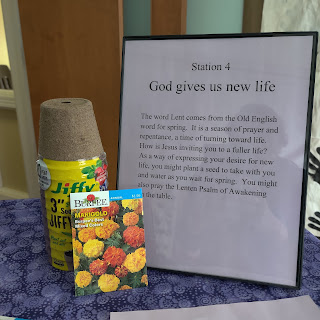
The song is on my mind again these days, as I bought marigold seeds and biodegradable pots and put them in the prayer room at church for Boston Square and Community Kids folks to pray with and plant.


It’s on my mind as I pray for God’s light and life to grow in me and through me.


And it’s on my mind, as I sit these words from Catherine of Sienna, a mystic and activist from the 1300s:


The sun hears the fields talking about effort

and the sun

smiles,


and whispers to

me,


“Why don’t the fields just rest, for

I am willing to do

everything


to help them

grow?”


Rest, my dears,

in Prayer.


And with this prayer, from Quaker Isaac Pennington:

Be no more than God has made you.

Give over your own willing;

Give over your own running;

Give over your own desiring to know or to be anything.

Sink down to the seed which God sows in the heart.

Let that grow in you;

be in you;

breathe in you;

act in you;

And you will find, by sweet experience, that the Lord

knows, loves, and owns that and will lead you

to the inheritance of life,

which is God’s portion.


Amen.

Wednesday, March 2, 2022

God's Grandeur

God’s Grandeur by Gerard Manley Hopkins

The world is charged with the grandeur of God.

            It will flame out, like shining from shook foil;

            It gathers to a greatness, like the ooze of oil

Crushed. Why do men then now not reck his rod?

Generations have trod, have trod, have trod;

            And all is scared with trade; bleared, smeared

            with toil;

            And wears man’s smudge and share’s man’s smell: the soil

Is bare now, nor can foot feel, being shod.


And for all this, nature is never spent:

            There lives the dearest, freshness deep down things;

And though the last lights off the black West went

            Oh, morning, at the brown brink eastward,

            springs—

Because the Holy Ghost over the bent

            World broods with warm breast and with ah!

            bright wings!


I usually think of this poem in the fall, with the brilliance of color that comes when the leaves change their colors, but it’s been on my mind this week, as we’ve walked to school in daylight, as the ice has mostly melted of the sidewalks (for now) and as the birds are beginning to brighten in color and to sing.


On Tuesday, Jay announced that it was the first day of meteorological spring. I hadn’t heard that term before and looked it up. Meteorologists divide the year into four seasons, based on date rather than temperature for purposes of record keeping. So meteorological spring is always March 1-May 31. It’s different from astronomical spring, which begins with the vernal equinox, which falls somewhere between March 19 and 21 each year. I sort of knew about that, and I looked up what the vernal equinox is (it’s when the sun is directly over the equator on its journey higher in the northern hemisphere sky, according to nbcnewyork.com). So there’s meteorological spring, astronomical spring and there’s also liturgical spring, which begins today, with Ash Wednesday.


The word Lent comes from the Old English word laencte, meaning the lengthening of daylight hours, or spring. Jennifer Holberg had a beautiful article about this on the Reformed Journal blog today, with an invitation to us to pay attention to the growing light. On Sunday I preached about my parents’ four-year-old friend who invited us to ‘prepare to be amazed,’ and since then I’ve been trying to pay attention to ordinary wonders. I’ve noticed the maple tree across from our house has buds on it, and the sun reflecting almost blindingly on the melting ice at the park across the street. And although the melting snow reveals some trash, and the world goes not well, ‘nature is never spent.’ The daylight is lengthening, and signs of life are returning, and it seems particularly amazing.


As we begin this Lent, this liturgical spring, may you sense the Spirit’s loving presence bent and brooding with warm breast and bright wings over our world and over you too.

Wednesday, February 23, 2022

Whirled Peas

This past Monday was Presidents’ Day. That, combined with Russia’s increased aggression in Ukraine, got me thinking about an extra-credit take-home math problem our daughters had to do for Algebra. It was one of those where the authors of the problem were trying to make math fun, so they opened the problem with a joke, and to get the answer you needed to solve a series of algebra problems that would then spell out the answer. 

In this case, the question was, “Why did the president put vegetables in the blender?” Both our girls had friends over, so they split into teams and decided to race to see who could come up with the answer first. The correct answer was supposed to be, “Because he wanted whirled peas.” Both teams quickly got to work, and once I figured out the answer myself, I spent most of the time trying to find a way to adjust the problem so the answer would use “she” instead of “he”.

It wasn’t too long, however, before the cry rang out, “We got it! We win!” “What’d you come up with?” I asked. “Because he wanted whirled pigs,” was the response. Hmm… I looked skeptically at the team claiming to win, trying to figure out in what world this answer might make any sense. Then I turned slowly to the other team and told them to keep working.

I find myself longing these days—not for whirled peas, but for world peace. I keep the image of the new heaven and the new earth in Revelation 21 in my mind. I wonder what it will be like when God completes what God promises to do in verse 5—make all things new. I long for the day when there will be no more sorrow or suffering or pain or death. I think quite a bit about Revelation 7:9-10, where there is a great multitude gathered around the throne of God, from every nation and tribe, people and language. And together they cry out in a loud voice—one voice, all together—“Salvation belongs to our God, who sits on the throne, and to the Lamb.”

Salvation is for all nations. All people. All languages. They’ll all be there before the throne. Ukrainians and Russians both. God loves us all, and it is salvation that brings us together. The work of God in our lives that breaks down those barriers that divide us. It is salvation that, in the end, will bring world peace. I wonder sometimes if it’s salvation from ourselves as much as anything else.

Does that mean we need to wait until Jesus returns to experience world peace? I hope not. I suspect, however, that, until Jesus returns, our fallen human natures, too often deep in the grip of sin, make world peace here and now pretty well unattainable. I’ll keep doing what I can, though. And encourage anyone who will listen to do what they can too. Even a glimmer of the peace of the Kingdom of Heaven would be welcome.

Shucks, I might even settle for whirled peace at the moment. Whirled peas, though, I think I’ll pass on. And whirled pigs—well, you can keep those for yourself.

Wednesday, February 16, 2022

Blessing and Butterflies

A couple of weeks ago I attended some of the Calvin Institute for Christian Worship’s annual Worship Symposium. Most of it was virtual, and this year’s theme was The Beatitudes. I’ve been drawn to the first Beatitude, ‘Blessed are the poor in spirit, for theirs is the kingdom of heaven,’ since preaching it a few years ago at Boston Square and reading Eugene Peterson’s translation of it in the Message: “You’re blessed when you’re at the end of your rope. With less of you there is more of God and God’s rule.” I have that ‘end of your rope’ feeling pretty often these days as we navigate another pandemic winter, and various family illnesses. I find the song ‘Come with me for the journey is long,’ often on my lips and in my heart.

One of the worship services I attended was the one based on ‘Blessed are the poor in Spirit,’ and the opening of the service was led by Kate Williams. She is an editor for GIA and a musician and she spoke these words of blessing at the service:

Blessed are those who are ready for change.

Blessed are those with their eyes squeezed shut, hoping it hasn’t started yet, waiting for it to pass.

Blessed are those with the freedom to embrace it as it happens.

Blessed are the colors and smells and crinkling sounds that remind us that time is still passing.

Blessed are those who are fading.

Blessed is the welcome coolness of a world on fire.

Blessed is the sacred cycle that teaches us rhythm and balance, of letting go and making room.

Blessed are those who dare to believe that their days will brighten again, someday. Blessed are those who do not know what will be next.

Blessed is the wisdom that teaches us to quiet, to listen, to allow the darkening days to do their work of renewal.

Blessed are those who are falling, who are weeping, who are waiting on bated breath, who are fearing to find that fragile hope once more.

Blessed is the God who catches all who fall, who is weeping with us, waiting with us, fearing with us, hoping with us. Always with us.

Blessed are those who bear witness to the love story of rising again, over and over.

I’ve been sitting with these words, finding myself in various lines, various days, holding on to the promise that God is always with us, remembering the love story of rising over and over.

Earlier this week I visited Fredrick Meijer Gardens. I noticed on Facebook last week that they had received their first shipment of chrysalises for the butterfly exhibit that officially begins in March, and I wanted to see if any of the chrysalises were moving yet. And some of them were! I heard a small child next to me counting the butterflies that had already emerged in the butterfly trailer– 17! – waiting to be strong enough to be released into the conservatory. I spent a long time staring at those freshly-emerged butterflies – their deep stillness as they wait for their new wings to dry. The slow beating of their wings when they can move them reminded me of breath – open/closed, in/out. Such fragility and beauty and newness and vibrant life. A few had already been released into the conservatory, including this one, getting its bearings on the ground not far from the trailer.

Butterflies are such powerful images of change, of dying to the old and rising to the new. Teresa of Avila writes about this, and talks about being held in the cocoon of God’s love as we die to our selves and emerge transformed.

This week may you remember that you are blessed, wherever you find yourself, and that you are held in the cocoon or chrysalis of God’s love.

Wednesday, February 9, 2022

Life without Chili Verde

The other day I tried a new recipe. I made chili verde. It was a tasty combination of shredded pork, green chilis, green enchilada sauce, onions, tomatoes, and a variety of spices. All in the instant pot, and an hour later it’s done. Perfect for a cold winter night. The only problem was, I was the only one who seemed to like it.

When we had leftovers night a few nights later, I was the only one who chose to have the chili verde. I noted how it was particularly good the second time around—the flavors had developed even more as it had time sit in the refrigerator.

In fact, I liked it so much this second time that I began thinking about having it again. There was just a bit remaining, so as I tucked it away in the refrigerator in a small leftover container, I thought about how it would make a wonderful lunch the next day.

The next morning, about mid-morning, my stomach started growling. Breakfast wasn’t lasting—I thought I might need a snack. But then I remembered the chili verde. And I smiled. And I knew something good was coming. And I decided to pass on a snack so I could enjoy the chili verde even more when lunch came around. Just the thought of enjoying that chili verde sustained me through the morning. Made me smile every time I thought about it.

But then lunch came. And I opened the fridge. And I went to grab the chili verde. Only…I couldn’t find it. I knew it was in there—I had put it there myself. I wondered if maybe it had gotten hidden behind some of the other leftovers, so I took most things out of the fridge and I searched each shelf carefully. No chili verde.

Then I had an unsettling thought—perhaps one of my daughters had taken the chili verde for their school lunch. But that couldn’t be…they didn’t even like the chili verde. I checked the leftover cornbread we had served with it. It too was gone! I begrudgingly made myself a sandwich and began plotting what to say to my daughter when she returned home from school.

When questioned upon her arrival, she didn’t even try to hide it. Yes, she had taken the chili verde. It was “not too bad,” she said. But why? Why would you do such a thing when you didn’t really even like the chili verde? When you knew there was a someone in the house who had a craving for chili verde? Someone—me—who was looking forward to eating the chili verde?

“Well,” came the explanation. “It was easier than making a sandwich.” Oof. I missed out on my chili verde because eating it was easier than making a sandwich.

I’ve learned to not hold things too tightly in this household. If I do, it’s liable to lead to disappointment. It’s just part of living with four other people. It’s not that they have things in for me or are trying to make my life miserable—it’s more that things don’t always go my way and I can’t always expect everything to go the way I want them to. Indeed, I’m actually kind of glad my daughter enjoyed the chili verde. It’s far more interesting culinary-wise than a sandwich, and it shows a willingness to try different foods—even ones she might not have liked all that much the first time. It makes me happy to see that adventurous spirit, even if it was adventure rooted in a matter of convenience. And it reminds me once again to put other people’s needs before my own. To set aside my own wants for the flourishing of others. To look to the interests of others, as Philippians 2:4 says. It just would have been far easier to deal with my disappointment if she hadn’t admitted that there was actually enough left for two. That she would have had plenty if she had just brought half of it and left some behind for me.

This has had me thinking quite a bit about the Christian life. We sometimes think that God owes us. That since we’ve given our lives to God, since we’ve made sacrifices for God, since we’ve been good and obedient and maybe even missed for God’s sake opportunities we would have liked to pursue—God owes it to us to make life easy for us. To give us a break or two along the way. We may even sometimes have our hearts set on something, and then it feels like it gets taken away from us at the last moment.

And then when things are hard, or life doesn’t turn out how we envisioned it would, or something devastating happens to us, or we miss out on something we had our heart set on, we get angry with God. We feel God has let us down somehow or we question whether God even exists or if God loves us. But God never promises that things will go well for us or that life will be easy. In fact, Jesus tells in Matthew 5 and Luke 6 to consider it pure joy when things are hard for us—when people persecute us or ridicule us for following Jesus. That means that it’s actually quite likely that life is going to hard sometimes. And it’s not difficult to look at the early church and see this playing out. Paul in Romans 5 tells us that we glory in our sufferings because suffering produces perseverance; perseverance, character; and character, hope. And that hope, Paul says, does not put us to shame. But to produce that hope, there will be suffering. There will be disappointment—at least it will seem like disappointment in the moment.

So even if we are suffering, even if life is hard, even if we are facing disappointment and the desires of our hearts are falling through our fingers, we must not give up hope. We won’t always know why God allows bad things to happen to us, but we do know God loves us. We know God loves us just by looking at Jesus and all God has done for us. And with God’s love in our hearts, we can endure all things. Even life without chili verde.